Public Projects

BNSF actively works with communities, businesses, and agencies across our network to execute public projects, and we place the highest value on the safety of our employees, those working on and around our property, and the public. Our Public Projects team is the point of contact for communities and other entities that have infrastructure projects that involve BNSF’s network. They are the driving force behind building and maintaining strong connections with our community partners and play a pivotal role in the progression of these projects - providing information, resources, and guidance for how to work alongside BNSF.

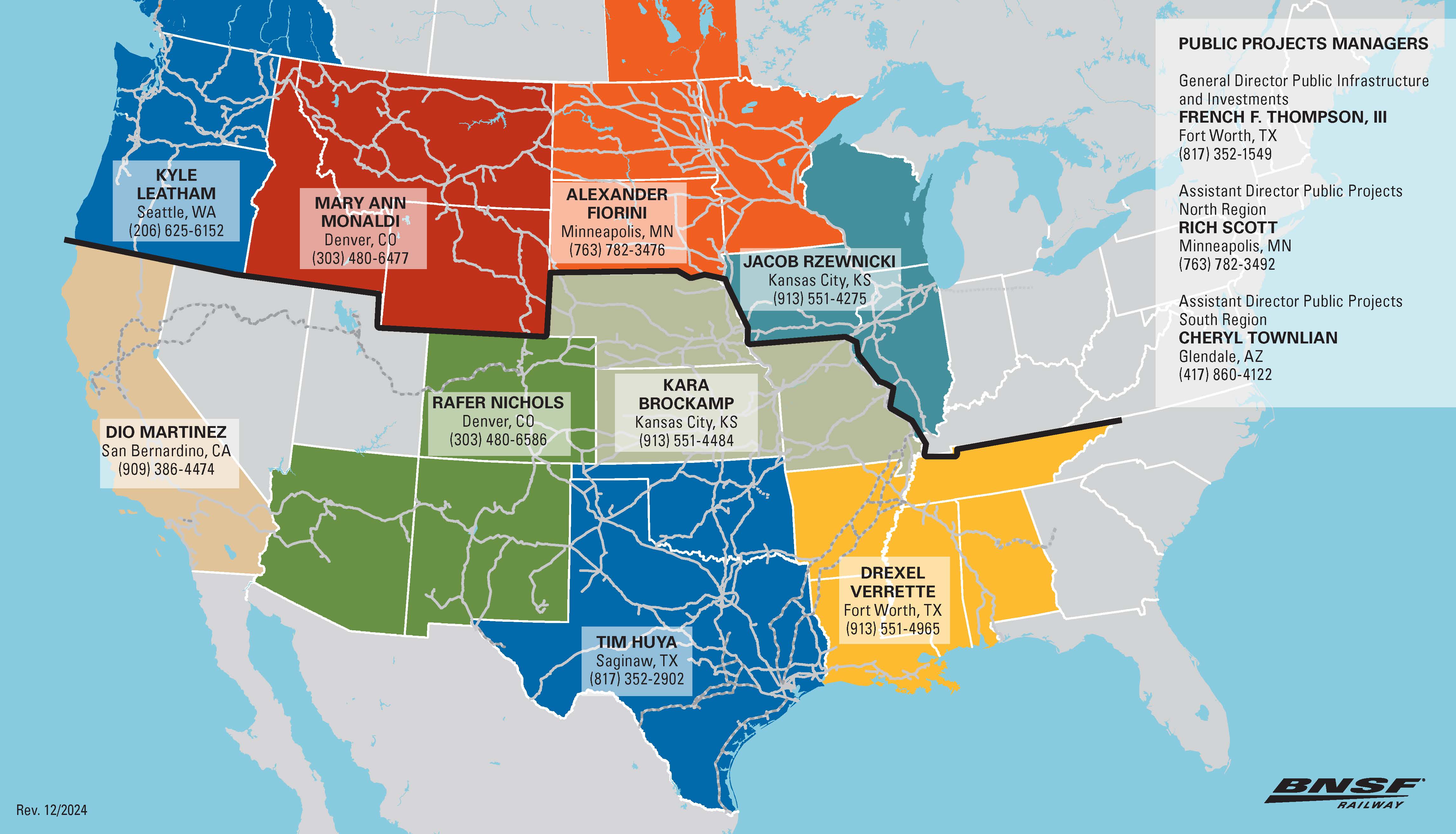
BNSF Public Projects Regions

ASSISTANT DIRECTOR, NORTH 

Rich Scott
Minneapolis, MN
763-782-3492
richard.scott2@BNSF.com


ASSISTANT DIRECTOR, SOUTH

Cheryl Townlian
Glendale, AZ
417-860-4122
cheryl.townlian@BNSF.com
GENERAL DIRECTOR

French F. Thompson, III
Fort Worth, TX
817-352-1549
french.thompson@BNSF.com


Public Projects Managers map

Public Projects Manual

BNSF’s Public Projects Manual serves as a resource for our community partners to deliver projects that are on or near BNSF Right-of-Way. The tools, guidance, and standards included in our manual articulate the essential steps to follow and important factors to consider as you plan your project. In today’s fast-paced, digital world, we understand the importance of having access to accurate and readily available information so that your projects can progress efficiently. Our manual empowers you to remain connected and informed and provides you with access to readily available information you need to deliver your critical projects.

Download Public Projects Manual - 2024

Quiet Zones

A Quiet Zone (QZ) is a section of rail line, at least one-half mile long, that contains one or more consecutive public crossings at which train horns are not routinely sounded, owing to the installation of various Supplemental Safety Measures (SSMs) or Alternative Safety Measures (ASMs), as identified in the Final Rule on the Use of Locomotive Horns at Highway-Rail Grade Crossings (49 CFR Part 222). BNSF strives to fully comply with the Final Rule, which provides requirements for the sounding of train horns. The Final Rule also provides guidance for conditions under which a public authority with jurisdiction over a grade crossing may apply for and establish continue a QZ through the Federal Railroad Administration process. All formal notices related to quiet zone creation or affirmation that are required to be submitted to the Railroad under the Final Rule should be submitted to BNSF’s Quiet Zone Mailbox