Contact Us
At BNSF, we are committed to providing you the information you need to make informed transportation decisions. If you would like more information on any of the subjects contained in this section, please feel free to complete our contact us form.
Safety & Security
| Name | Contact |
|---|---|
| Emergencies | 1-800-832-5452 option 1 |
| Report Train Blocking Crossing | 1-800-832-5452 option 3 |
| Report Trespasser or Criminal Activity | 1-800-832-5452 option 4 |
| Careers | Resource Protection |
| GIS Data Collection | BNSF GIS Data Collection Form |
BNSF Police Team
| Name | Title |
|---|---|
| Bryan Laurie | Chief of Police |
| Steven L. Wells | Assistant Chief of Police, Southeast Corridor: Arizona, Louisiana, Kansas, Missouri, New Mexico, Oklahoma, Texas |
| Gina Hunter | Assistant Chief of Police, Northeast Corridor: Alabama, Arkansas, Georgia, Iowa, Illinois, Michigan, Minnesota, Mississippi, Tennessee, Wisconsin |
| Israel A. Salazar | Assistant Chief of Police, Southwest Corridor: California, Nevada |
| Tyler D. Nies | Assistant Chief of Police, Northwest Corridor: Canada, Colorado, Idaho, Montana, Nebraska, North Dakota, Oregon, South Dakota, Utah, Washington, Wyoming |
| Jeff Briggs | Assistant Chief of Police, Special Investigations, K9 & Training |
Customers
Connect with BNSF (Non Intermodal Customers)
Customer Assistance
Shipment support questions: 888-428-BNSF (2673)
See a phone option guide.
Media Requests
Email the Media Request Team. Please include your name, title, organization, location, email, phone number and deadline in your request.
Careers
Visit jobs.bnsf.com or email Staff.Recruiter1@bnsf.com.
Employee Verification
BNSF employee verifications may be submitted at www.theworknumber.com or by calling 1-800-367-5690.
BNSF's Company Code: 10532
Community Questions
Please use our Contact Us form. Use of this form will help us to direct your inquiry to the right person and track the progress of our response.
Journalists: Email the Media Request Team. Please include your name, title, organization, location, email, phone number and deadline in your request.
Fixed Income Investors
For all questions relating to BNSF issued debt securities, please contact:
| Name | Title | Contact |
|---|---|---|
| Mark Bracker | Treasurer | 817-352-3478 BNSF Investor Inquiries |
Federal Government Contacts
| Michael R. Smythers Jr. VP, Federal Government Affairs |
Tel: 202-347-8662 |
| Gael Sullivan General Director, Federal Government Affairs |
Tel: 202-347-8671 |
| Justin T. Wormmeester General Director, Federal Government Affairs |
Tel: 202-347-8704 |
| Elizabeth Bender Manager, Federal Government Affairs |
Tel: 202-661-0446 |
| Erika Hartingh Manager, Federal Government Affairs Treasurer, BNSF RailPAC |
Tel: 202-661-0445 |
State Government, Community and Tribal Contacts
| Location | Name | Phone |
|---|---|---|
| Arizona, Northern California, Nevada, Utah | Cyndi Hillery Executive Director Public Affairs |
|
| North Dakota, South Dakota | Amy McBeth General Director Public Affairs - East |
Tel: 763-782-3212 |
| Southern California | Lena Kent General Director Public Affairs |
Tel: 909-386-4140 |
| New Mexico, Oklahoma, Texas | Lindsay Mullins Executive Director Public Affairs |
Tel: 512-517-8535 |
| Idaho, Montana, Wyoming | Matthew Jones General Director Public Affairs - West |
Tel: 406-256-4047 |
| Oregon, Washington, British Columbia | Johan Hellman Executive Director Public Affairs |
Tel: 206-625-6135 |
| Missouri, Nebraska | Jeff Davis Executive Director Public Affairs |
Tel: 913-551-4202 |
| Alabama, Arkansas, Louisiana, Mississippi, Tennessee | Michael Garriga Executive Director Public Affairs |
Tel: 901-433-5040 |
| Illinois, Iowa | Peter Skosey Executive Director Public Affairs |
Tel: 312-850-5678 |
| Minnesota, Wisconsin | Lydia Underdahl Executive Director Public Affairs |
Tel: 651-298-2458 |
| Colorado, Kansas | Andy Williams Executive Director Public Affairs |
Tel: 817-867-6369 |
| Corporate | Zak Andersen Vice President Corporate Relations |
Tel: 817-867-6250 |
Passenger Service
| Name | Contact |
|---|---|
| Chicago Suburban Service (Metra) | Tel: 312-322-6777 Visit Metra website for schedules and other information |
| Metro Transit (Minneapolis) | Tel: 612-373-3333, option 3 Visit Metro Transit for more information |
| Sounder Transit (Seattle) | Tel: 206-398-5000 |
Public Projects
BNSF's Public Projects team is the point of contact for the communities we serve when they desire to deliver infrastructure projects that cross, intersect, or parallel BNSF’s network in some way.
How do I work with Public Projects?
Visit our Public Projects page, which contains the Public Projects Manual and links to the technical appendices associated with the manual.
Real Estate
Land Revenue Management
BNSF's Real Estate professionals are responsible for management of one of the company's largest assets, land. Assuring an appropriate return for the use or disposition of land, this group oversees land sales, leases, permits and other revenue generating land transactions. In addition they oversee a number of outsource providers, including Jones Lang LaSalle Brokerage, Inc., to facilitate preparation and execution of agreements and negotiation of terms to a mutually acceptable resolution.
Need a Permit?
If you have questions about gaining access to BNSF property, visit our Property Permits & Licenses page.
Rail Development
Are you expanding or developing a new facility? You can count on BNSF experts to help educate you on the benefits of incorporating our rail network as part of your supply chain solutions. BNSF's Economic Development team can help guide you through all aspects of expanding, developing or selecting a site. Consult the table below to identify and contact the regional manager in your specific territory.
For track-related inquiries and incidents, please contact the BNSF Resource Operations Call Center at 1.800.832.5452.
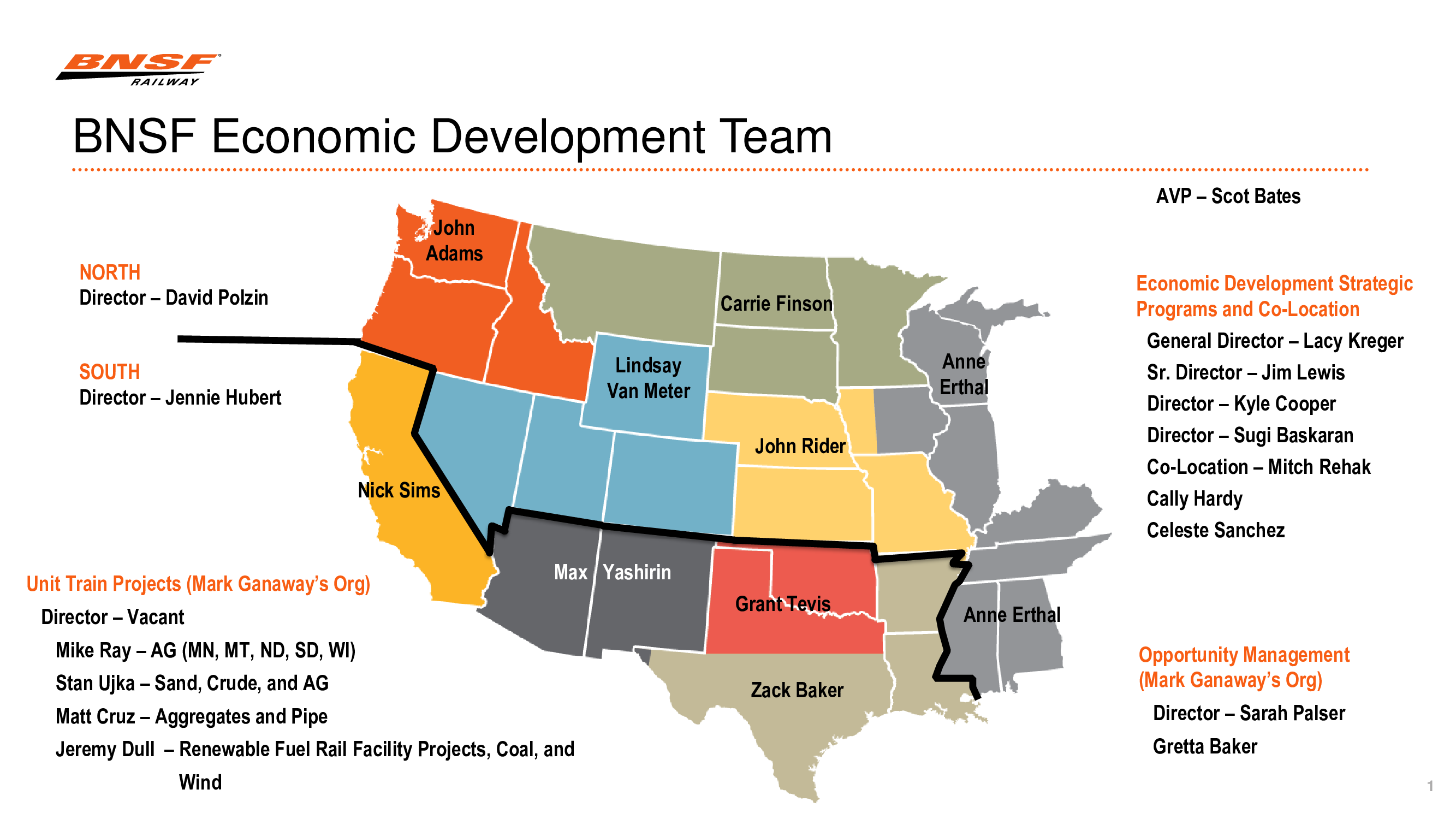
| Name | Contact | |
|---|---|---|
| North Director | David Polzin | Tel: 817-867-6467 |
| Idaho, Oregon, Washington, British Columbia | John Adams | Tel: 206-625-6355 |
| Montana, North Dakota, South Dakota, Minnesota, Manitoba | Carrie Finson | Tel: 360-567-7801 |
| Central and Eastern Iowa, Illinois, Wisconsin, Alabama, Mississippi, Tennessee | Anne Erthal | Tel: 312-850-5699 |
| Colorado, Nevada, Utah, Wyoming | Lindsay Van Meter | Tel: 303-480-6440 |
| Western Iowa, Kansas, Missouri, Nebraska | John Rider | Tel: 913-551-4148 |
| South Director | Jennie Hubert | Tel: 817-307-7250 |
| California | Nick Sims | Tel: 626-208-6797 |
| Arizona, New Mexico | Maksim Yashirin | Tel: 928-289-7230 |
| South Texas, Louisiana, Arkansas | Tyler Geyer | Tel: 817-867-6521 |
| Oklahoma, North Texas | Grant Tevis | Tel: 817-913-7710 |
| Assistant Vice President | Scot Bates | Tel: 817-821-8886 |
Unit Train Contacts
| Area | Name | Contact |
|---|---|---|
| Director | Sarah Palser | Tel: 817-352-2291 |
| Pipe and Aggregates | Tracey Sanders | Tel: 817-234-1614 |
| Sand, Crude, and Agriculture (All other States) | Stan Ujka | Tel: 913-551-4146 |
| Agriculture (MN, MT, ND, SD, WI) | Jeremy Dull | Tel: 817-867-6566 |
| Renewable Fuel Rail Facility Projects, Coal and Wind | John Elmore | Tel: 806-452-9652 |
New to Rail or BNSF?
Learn how easy it is to become a BNSF customer. We will show you how to get a rate, ship, track and manage your account.
GET STARTED
WHAT CAN YOU SHIP?
Our consistent and cost-effective service takes products of any size to customers where they need them.

WHERE CAN YOU SHIP?
BNSF's network can get you there – no matter where you're shipping your freight.

HOW CAN YOU SHIP?
You can rely on our best-in-class services to deliver your goods in the most cost-effective manner.